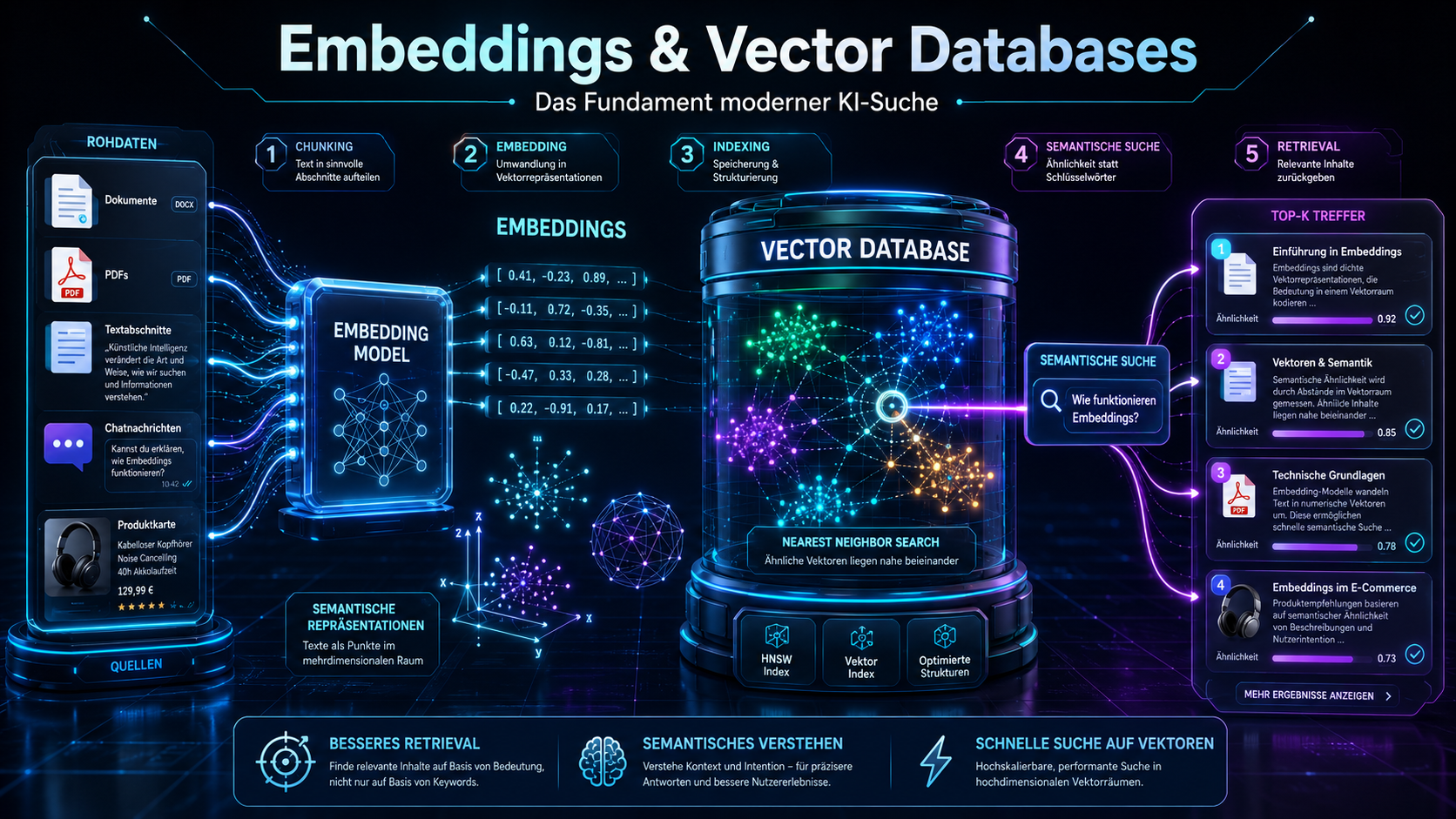
If you build a productive AI system in 2026, you can’t avoid embeddings and vector databases. They are the invisible foundation supporting RAG, semantic search, recommender systems and knowledge hubs. Skipping them produces systems that look like demos but fail in production. This article explains the building blocks — from embedding models through chunking to indexes and hybrid search.
1. What are embeddings?
An embedding is a numerical representation of meaning. Specifically: a vector with typically 512 to 4,096 numbers, locating a text, image, or other input in a high-dimensional space. Content with similar meaning lives close together; dissimilar content sits far apart.
Practical consequence: similarity between content can be computed as distance between vectors. Cosine similarity (1 = identical, 0 = unrelated) is the common metric. That enables search that isn’t based on exact word matches — but on semantic closeness.
Example: A search for “repair the car” also finds texts about “fix the vehicle,” even with no word overlap. That’s the value of embedding search beyond classical full-text search.
2. Embedding models in 2026
Embedding models have specialized strongly in recent years. In 2026 these families matter:
- Multilingual: bge-m3, jina-embeddings-v3, Cohere Embed. Solid quality across German, English, Romance languages. bge-m3 is open weight and supports sparse and multi-vector modes too.
- English-focused: OpenAI text-embedding-3, Voyage AI, e5-Mistral. Higher precision on English texts but often weaker for German.
- Domain-specialized. Code, legal, medical, financial — specialized embeddings substantially outperform generic models in their niche. For sensitive domains, fine-tuning an embedding model on your own data is often worth it.
Important axis: dimensionality. Smaller embeddings (256–768) are cheaper to store and search. Larger (1,024–4,096) are often more precise. Modern models support matryoshka representation learning — a single embedding can be truncated to various dimensions without recomputation.
3. Chunking — the underestimated discipline
An embedding is only as good as its input. Storing a 100-page PDF as one embedding loses granularity. Storing one embedding per sentence loses context. Chunking — splitting documents into semantically meaningful units — is the most underestimated discipline in RAG.
Proven strategies:
- Fixed-size chunking. Simple: cut every 500 tokens. Robust but blind to semantic boundaries.
- Semantic chunking. Cuts at sentence or paragraph boundaries. Better, a bit more work.
- Recursive chunking. Hierarchical: first by sections, then paragraphs, then sentences.
- Document-aware chunking. Respects structure (headings, lists, tables). Best quality, highest effort.
Overlap between chunks (10–20%) protects against splitting connected statements. Chunking strategy often affects RAG quality more than the embedding model.
4. Vector databases at a glance
A vector database stores vectors plus metadata and enables efficient similarity search. In 2026 these options are productive:
- pgvector. PostgreSQL extension. Biggest advantage: lives in the same stack as the rest of the app. Solid performance up to tens of millions of vectors. Best choice for many enterprises.
- Qdrant. Open source, Rust-based, very performant. Local or cloud. Strong filter API.
- Weaviate. Open source with GraphQL interface and integrated reranking modules. Slightly more involved to operate.
- Milvus. Scales to billions of vectors. For very large setups.
- Pinecone, MongoDB Atlas Vector Search. Managed services. Fast to start, vendor lock-in risk.
For most mid-market applications pgvector is the pragmatic entry. For very large indexes or specific performance needs, Qdrant or Milvus pay off.
5. ANN indexes: HNSW, IVF, ScaNN
A naive search across millions of vectors is too slow. Vector databases use approximate nearest neighbor (ANN) indexes that deliver fast answers by trading some accuracy — typically reaching 95–99% recall of the true top-K.
Key indexes:
- HNSW (Hierarchical Navigable Small World). Standard for medium to large indexes. Very fast, good quality, higher memory use.
- IVF (Inverted File Index). Cluster-based. Good for very large indexes, somewhat slower than HNSW.
- ScaNN, FAISS, DiskANN. Specialized indexes for specific workloads (disk-based, very high-dimensional).
Important HNSW hyperparameters: M (connectivity), ef_construction (build quality), ef_search (search quality). Defaults in most databases are usable; tuning matters only at performance bottlenecks.
6. Metadata filters and hybrid search
Pure embedding search is rarely enough. Productive setups combine:
- Metadata filters. Only vectors matching SQL-like conditions (language, date, source, tags). Vector databases support this natively.
- Hybrid search. Combination of dense (embeddings) and sparse search (BM25, full-text). Captures both semantic similarity and exact terms.
- Reranking. After initial search, the top-100 is re-sorted by a stronger cross-encoder model. Highly effective for precision.
Together these three techniques deliver substantially better answer quality in enterprise RAG than pure vector search. More in Hybrid search, reranking and GraphRAG.
7. Practice: what really matters
Crystallized from 30+ RAG projects:
- Data quality. Bad sources produce bad answers. Cleaning, dedupe, versioning is the invisible main work.
- Chunking strategy. Matters more than the embedding model. Spend time on it.
- Hybrid search from day one. Pure vector search rarely suffices.
- Reranking when quality lags. Cross-encoder rerankers give the final precision boost.
- Eval suite. Realistic test questions with expected sources. Without eval, optimization is gut feeling. Details in Guardrails, evals and prompt injection.
- Monitor embedding drift. Switching the embedding model invalidates old embeddings. Plan reindex strategy from the start.
Embeddings and vector databases in 2026 are the basic tooling of every productive AI application that touches your own data. Set up cleanly, you get a system that grows with your content, runs on your infrastructure, and improves continuously. Treated as a technical afterthought, you get a chatbot that answers nicely but wrongly. The difference is almost never the LLM — it’s what happens before the LLM.
Frequently asked questions.
/ 01What exactly is an embedding?
An embedding is a vector (typically 512–4,096 numbers) representing the meaning of a text, image, or other input in a high-dimensional space. Texts with similar meaning have similar vectors — measured by cosine similarity or Euclidean distance. Embeddings bridge human language and mathematical computation.
/ 02Why do I need a vector database?
Classical databases search efficiently by exact values. A vector database searches by similarity — across millions or billions of vectors in milliseconds. That's the foundation for semantic search, RAG, recommendation systems and cluster analyses.
/ 03Which vector databases matter in 2026?
For enterprises: pgvector (a PostgreSQL extension, especially easy to add to existing stacks), Qdrant (open source, very performant, cloud or self-hosted), Weaviate (open source with GraphQL interface), Milvus (for very large volumes). For cloud setups: Pinecone, MongoDB Atlas Vector Search.
/ 04How do I choose the right embedding model?
Three axes: language (multilingual or English-focused), domain (general or specialized), dimensionality (smaller is cheaper, larger is often more precise). For German texts, bge-m3, jina-embeddings-v3, or fine-tuned open-weight models are good starting points. For specialized domains, fine-tuning an embedding model on your own data often pays off.
/ 05How does embedding search compare to classical full-text search?
They complement each other. Embedding search finds semantically similar content without literal word matches. Full-text (BM25) finds exact terms — important for names, codes, jargon. Modern setups combine both in hybrid search. Details in Hybrid search, reranking and GraphRAG.
/ 06How large should chunks be when indexing?
Rule of thumb: 200–800 tokens per chunk with 10–20% overlap. Shorter chunks raise precision, longer ones preserve context. For long documents a hierarchical strategy helps: finer chunks for search, coarser for display. Chunking strategy often matters more than the embedding model.