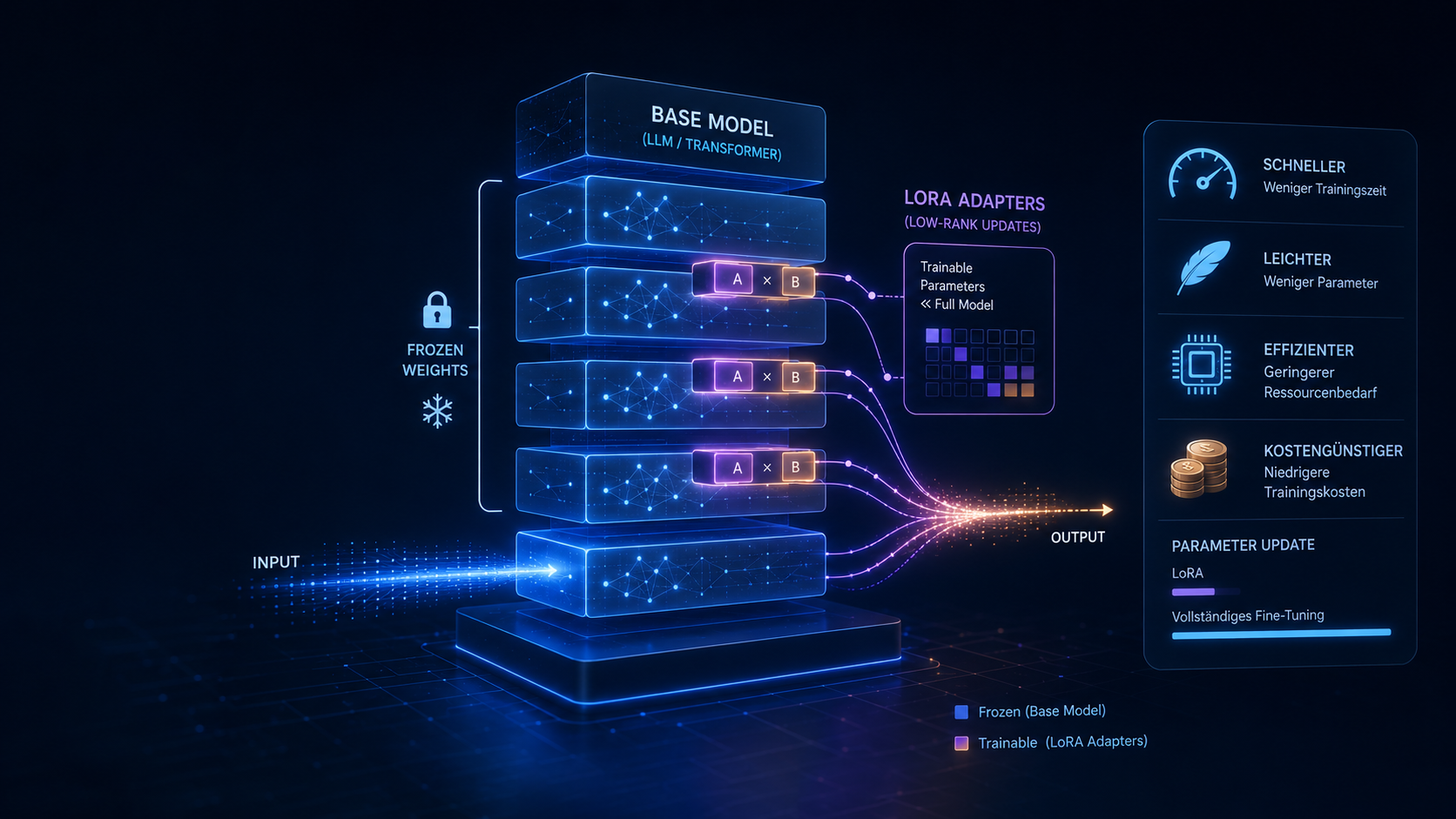
LoRA — low-rank adaptation — is one of the most important methods that made fine-tuning large language models possible for normal companies in the first place. Instead of changing billions of model weights, only tiny adapter matrices are trained. That cuts cost, hardware needs and training time by one or two orders of magnitude — often with almost identical quality. This article explains how it works and when to use it.
1. The problem with classical fine-tuning
A modern LLM has 8 to 70 billion parameters, research models even hundreds of billions. Full fine-tuning means training all of them. That creates three problems:
- Memory. Training requires multiple model sizes in GPU RAM (model, gradients, optimizer state). Full fine-tuning a 70B model needs hundreds of GB of VRAM — several high-end GPUs in a cluster.
- Cost. GPU hours for multi-node training quickly add up to five- or six-figure budgets.
- Catastrophic forgetting. Changing all weights can make the model lose general capabilities it had before fine-tuning. It specializes at the cost of versatility.
For most enterprise applications that’s overkill. You don’t want a fundamental behavior change — you want specialization in a niche without damaging the base model.
2. The LoRA idea: low-rank adaptation
LoRA is based on a mathematical observation: the changes a model picks up through fine-tuning almost always live in a low-dimensional subspace. So learning just a low-rank approximation to the change suffices — the high dimensionality of the full model isn’t needed.
Concretely: instead of modifying a large weight matrix W, LoRA learns two small matrices A and B whose product is a low-rank approximation to the change. The effective weight matrix becomes W + B·A. If W is 4,096×4,096 (about 17M parameters) and rank r=16, then A is just 16×4,096 and B 4,096×16 — together about 131,000 parameters. That’s a reduction below 1%.
In practice, adapters typically sit in the attention layers (query, key, value, output projections), sometimes also in the feed-forward layers. The choice affects quality and training cost.
3. Why LoRA works
Empirically LoRA reaches 90–98% of full fine-tuning’s quality on most adaptation tasks. Three explanations:
- Low-rank hypothesis. The changes needed for most specializations are genuinely low-dimensional. Well supported by studies on the intrinsic dimension of LLM updates.
- Pretraining preserves general capabilities. Because the base model stays frozen, its general capabilities aren’t lost — no catastrophic forgetting.
- Regularization effect. Constraining updates to low rank acts as implicit regularization and reduces overfitting on small datasets.
4. LoRA in practice
A typical LoRA setup with Hugging Face PEFT and Transformers:
from peft import LoraConfig, get_peft_model
from transformers import AutoModelForCausalLM

base = AutoModelForCausalLM.from_pretrained("meta-llama/Llama-3.1-8B")

config = LoraConfig(
    r=16,
    lora_alpha=32,
    target_modules=["q_proj", "k_proj", "v_proj", "o_proj"],
    lora_dropout=0.05,
    bias="none",
)

model = get_peft_model(base, config)
model.print_trainable_parameters()
# >>> trainable params: 20M (0.25% of total)
On a single 24-GB consumer GPU (RTX 4090, RTX 5090) you can fine-tune an 8B model on 5,000 examples in a few hours. With QLoRA (next section) even a 70B model on a 48-GB GPU.
Key hyperparameters:
- Rank r: 8 to 64. For 8B models often r=16, for larger models r=32 or higher.
- Alpha: Scaling factor, usually twice the rank.
- Dropout: 0.05–0.1 for regularization.
- Target modules: Which layers get adapters. More layers = more capacity, but more training work.
5. Variants: QLoRA, DoRA, Spectrum
QLoRA (Quantized LoRA) combines LoRA with 4-bit quantization of the base model. That enables fine-tuning on even smaller hardware — a 70B model on a single 48-GB GPU. Details in QLoRA and quantization.
DoRA (Weight-Decomposed Low-Rank Adaptation) decomposes the update matrix into magnitude and direction and trains both separately. Slightly better than plain LoRA on many benchmarks, with marginally more overhead.
Spectrum is a newer method that identifies the layers with the highest signal-to-noise ratio and trains only there. More efficient and often better than blindly applying LoRA to all attention layers.
In practice LoRA with standard hyperparameters suffices for most tasks. Variants bring 1–3% quality improvements but justify the extra effort only in mature setups.
6. When LoRA is the right choice
LoRA fits use cases with these properties:
- Behavior adaptation rather than knowledge addition. Tone, format, domain language, structured outputs. This is closely related to how base models are shaped through instruction tuning, RLHF and DPO.
- Datasets of 500–50,000 examples. Enough for real adaptation, small enough for efficient training.
- Modularity desired. Multiple specializations on one base model without storage duplication.
- Limited hardware. One to four GPUs, local or rented.
- On-premise or sovereignty needs. Open-weight model plus your own LoRA training = full data sovereignty. See Secure AI integration.
If the task is more knowledge-oriented (answering questions from documents), RAG is the better choice. Comparison in RAG, fine-tuning or prompt engineering.
7. Limits and trade-offs
LoRA isn’t a fit for everything:
- Deep behavior changes. When the model should learn something fundamentally new (a new language, a wholly new modality), LoRA often isn’t enough.
- Latency with unmerged adapters. Loading adapters at runtime costs a few percent latency — relevant at high inference frequency.
- Choice of target modules. Wrong hyperparameters can yield worse results than a generic model.
- Eval remains mandatory. A LoRA adapter can still hallucinate, amplify biases or miss edge cases. Without structured evaluation the effect isn’t measurable — details in Guardrails, evals and prompt injection.
LoRA is the standard tool for most enterprise specialization tasks in 2026. Ignoring it and either staying with pure prompt engineering or jumping to full fine-tuning leaves substantial efficiency on the table. With some discipline in dataset curation and evaluation, an open-weight base model plus a trained adapter becomes a productive, domain-specific system — sovereign, controllable, and free of vendor lock-in.
Frequently asked questions.
/ 01How many parameters does LoRA actually train?
Typically 0.1–1% of a model's total parameters. For a 7B model that means 7–70 million parameters instead of seven billion. That dramatically reduces GPU memory needs and makes training possible on a single consumer GPU.
/ 02What is the rank in LoRA?
The rank (r) determines the size of the adapter matrices. Common values are 8, 16, 32, or 64. Higher rank means more trainable parameters and potentially more adaptation capacity — but also more memory use and overfitting risk. For many use cases, r=16 is a good starting point.
/ 03Does LoRA change the base model?
No, that's the core advantage. Original weights stay frozen. Adapters are stored separately and can be loaded or unloaded at runtime. That makes several specializations on one base model possible without duplicating the large model.
/ 04Can multiple LoRA adapters be combined?
Yes, that's one of its strengths. Multi-adapter setups let you run one base model with various specializations — for example a medical and a legal adapter on the same model. Frameworks like LoRAX or S-LoRA specialize in such setups.
/ 05Can I merge LoRA adapters into the base model?
Yes, that's called adapter merging. The adapter weights are mathematically folded into the base model, which speeds up inference — no extra matrix op at runtime. Downside: after merging, the adapter is no longer separately swappable.
/ 06What's the data requirement for LoRA?
Much lower than full fine-tuning. For well-defined tasks 500–5,000 high-quality examples are often enough. Data quality matters more than volume. Synthetic data reduces the need further — details in Synthetic data.