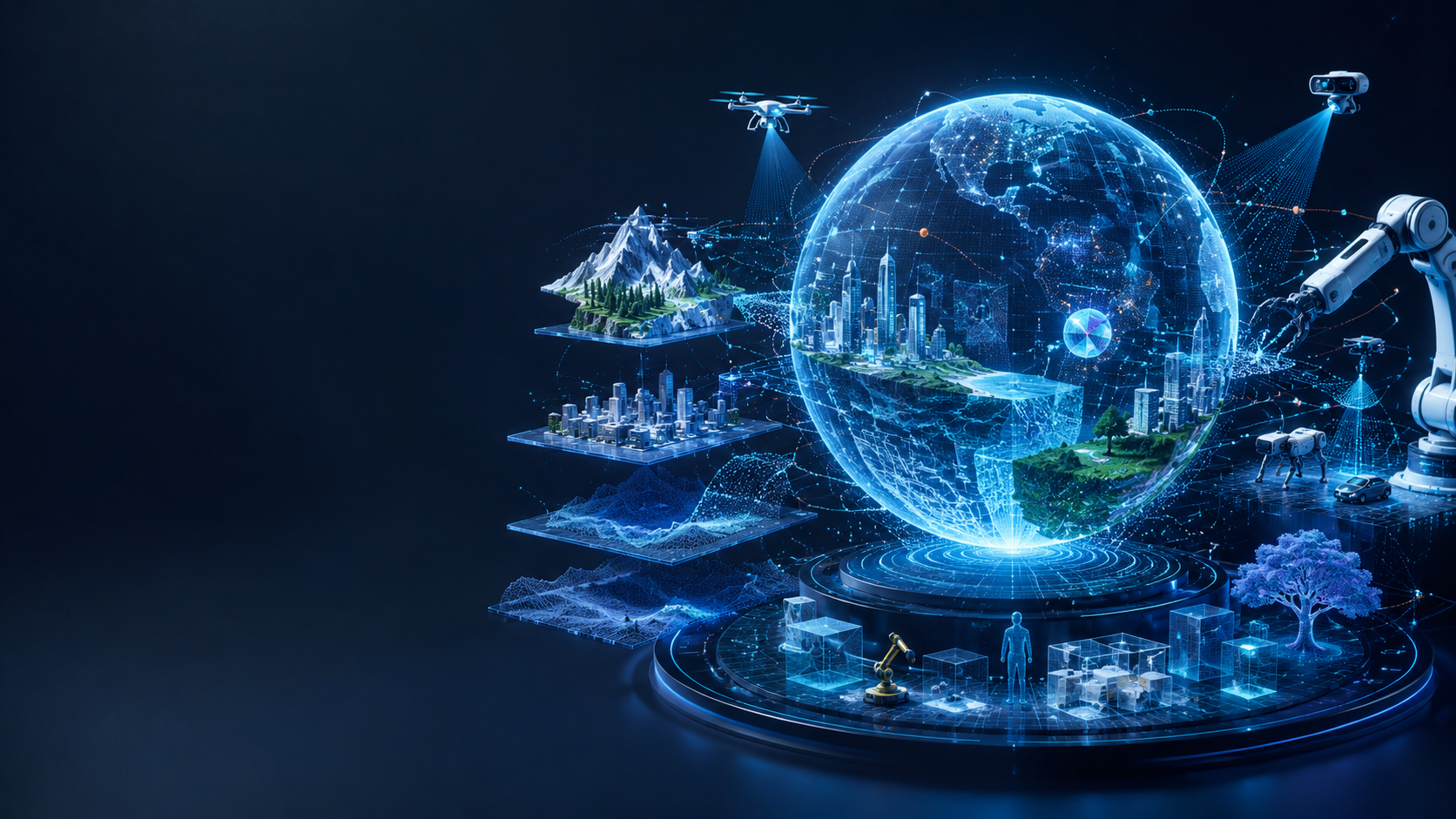
Language models have dominated the past few years — rightly so, because language is a universal interface. But language alone isn’t enough to act in the physical world. If you want to steer robots, plan factories, or model a transport system, you need a model of the world, not just of words. That’s what world models are about — one of the most active research directions in 2026.
1. What world models are
A world model is a learned model of the dynamics of an environment. Mathematically it estimates a distribution of the form:
P(next state | current state, action)
It takes an observation and a planned action and predicts what happens next. That sounds like reinforcement learning, but the framing is broader: a world model can also operate without explicit actions and simply learn the natural dynamics of an environment.
The key idea: a system that can predict the world can plan without experimenting in the world — it can play out in its head what an action would do. That saves data, time, and risk.
2. How world models differ from LLMs
An LLM models the probability of the next token in a text stream. It knows an enormous amount of world knowledge but has no direct sense of physics, space, or time. It knows that a falling cup breaks — because it read so in texts. But it can’t reliably predict when, how, and into which fragments.
World models train on different data: video, sensor time series, robot telemetry, simulations. Their output isn’t text but an expected observation — a next image, a next sensor reading, a next state vector. They are often smaller than today’s frontier LLMs but more specialized and more tightly coupled to the structures of the physical world.
In 2026 practice you see hybrid architectures: an LLM provides the symbolic representation and planning language, a world model provides physical consistency. Such hybrid systems are the foundation for AI agents that don’t only talk but also act.
3. Three current research families
As of 2026, three conceptual families dominate:
- JEPA and successors (Meta). Train on masked prediction in a latent space rather than on pixel reconstruction. More efficient, more abstract, but visually less impressive.
- Diffusion-based world models. Apply diffusion techniques (as in image generators) to video and sensor sequences. Best visual quality, high compute cost. Examples: Sora, Genie, several research models at Wayve and Waymo.
- Token-based world models. Discretize the world into tokens and let a transformer predict next sequences. Conceptually close to LLMs, easy to steer, data-hungry.
Which family wins is open. More likely than a clear winner: specialized models per domain (robotics, autonomous driving, industrial simulation) rather than a single universal frontier world model.
4. Robotics and embodied AI
Robotics is the most obvious application. A robot learning without a world model needs enormous amounts of real trials — expensive, slow, dangerous. With a solid world model, the robot can do most of its trials in the simulation space and only the critical 10–20% in reality.
Concrete effects measurable in 2026:
- Real training time for new tasks reduced by 5–20×.
- Better generalization to unknown objects and environments.
- Safer testing of dangerous actions (tool guidance, human-robot interaction).
For mid-sized companies this matters in industrial manufacturing, intralogistics, and inspection. For more on automating processes, see AI process automation.
5. Digital twins for industry and manufacturing
Digital twin is an older industrial term — the digital representation of a physical plant. Classic digital twins are built on physical simulation: fluid dynamics, finite element methods, discrete event simulation models. They are accurate but often slow and expensive to maintain.
World models add three things:
- Learned components for areas where classical physics is hard to model (material behavior under real load, complex process steps).
- Faster prediction — one inference instead of one simulation.
- Combinability with LLM interfaces for natural-language what-if questions.
Realistic 2026 picture: world models complement classical digital twins, they don’t replace them. The truly productive architectures combine physical simulation, data-driven prediction, and LLM interfaces.
6. Video generators as implicit world models
Diffusion-based video generators like Sora, Veo and Genie have a side effect that is conceptually important: to generate plausible videos, they must implicitly learn physics. They know that water flows, that shadows must be consistent, that objects don’t suddenly disappear.
That makes them implicit world models. For pure content production that is enough; for industrial control it is too unspecific and unstable. An exciting bridge is emerging in 2026: research teams are starting to turn these video models, through targeted fine-tuning, into steerable world models — with actions as input and reproducible dynamics.
7. Practical relevance in 2026
For most mid-sized companies, directly deploying world models is not the right investment field today. But strategic thinkers should prepare three things:
- Collect data that becomes useful later. Sensor data, machine telemetry, process measurements. Not because you’ll train a world model today, but because without that data you couldn’t train one tomorrow.
- Decouple the architecture. Simulation, control and reporting should already be separable enough that individual components can be swapped for learned models. See also AI consulting: where to start.
- Define pilot fields. Which process, if supported by a world model, would have the largest leverage? Doing this analysis up front separates early adopters from spectators.
World models in 2026 sit roughly where LLMs sat in 2020: exciting, technically maturing, productive in pockets, broadly still ripening. In two to four years they will be a normal component of specialized platforms — industrial control, robotics, AR/VR. Whoever builds the data foundations now will have the head start later.
Frequently asked questions.
/ 01What exactly is a world model?
A world model is a learned model of the dynamics of an environment. Given a current state and an action, it predicts the resulting next state. Unlike an LLM, which models probabilities over the next token, a world model models probabilities over the next observation — i.e. what will happen next in the world.
/ 02Aren't world models and video generators the same thing?
Video generators like Sora, Veo or Genie 2 are a special case: they model visual dynamics and therefore implicitly learn physics. But they're primarily optimized for visual quality, not physical consistency. A true world model is designed for reproducible, steerable prediction — even if the result looks less photorealistic.
/ 03Where do industries need world models?
Three major fields: (1) Robotics and manufacturing — robots learn tasks faster and more safely in a simulated environment. (2) Digital twins — continuous prediction of plant, energy or material-flow behavior. (3) Operations planning — what happens if we reconfigure the line, change shifts, introduce a new product?
/ 04How are world models related to AGI?
Many leading researchers (Yann LeCun among others) argue that pure language models can't become true general intelligences because they lack an internal world model. World models are seen as a key building block for embodied AI — AI that can act in a physical environment. Whether this leads to AGI is open; that it addresses gaps in today's systems is consensus.
/ 05Which open-source projects exist for world models in 2026?
Relevant lines of work include the JEPA family (Meta), Genie and SIMA (Google DeepMind), NVIDIA's Cosmos for robotic simulation, plus various academic publications on diffusion-based world models. Industrial applications are emerging at Tesla, Wayve and several robotics startups.
/ 06Can a mid-sized company deploy world models today?
Directly training one — rarely. For classic industrial and logistics questions, a well-built digital twin with classical simulation plus LLM-assisted control is almost always sufficient in 2026. World models will percolate into specialized platforms (simulation, robotic control, AR/VR) over the next 2–4 years. Today the right move is to prepare the architecture for them.