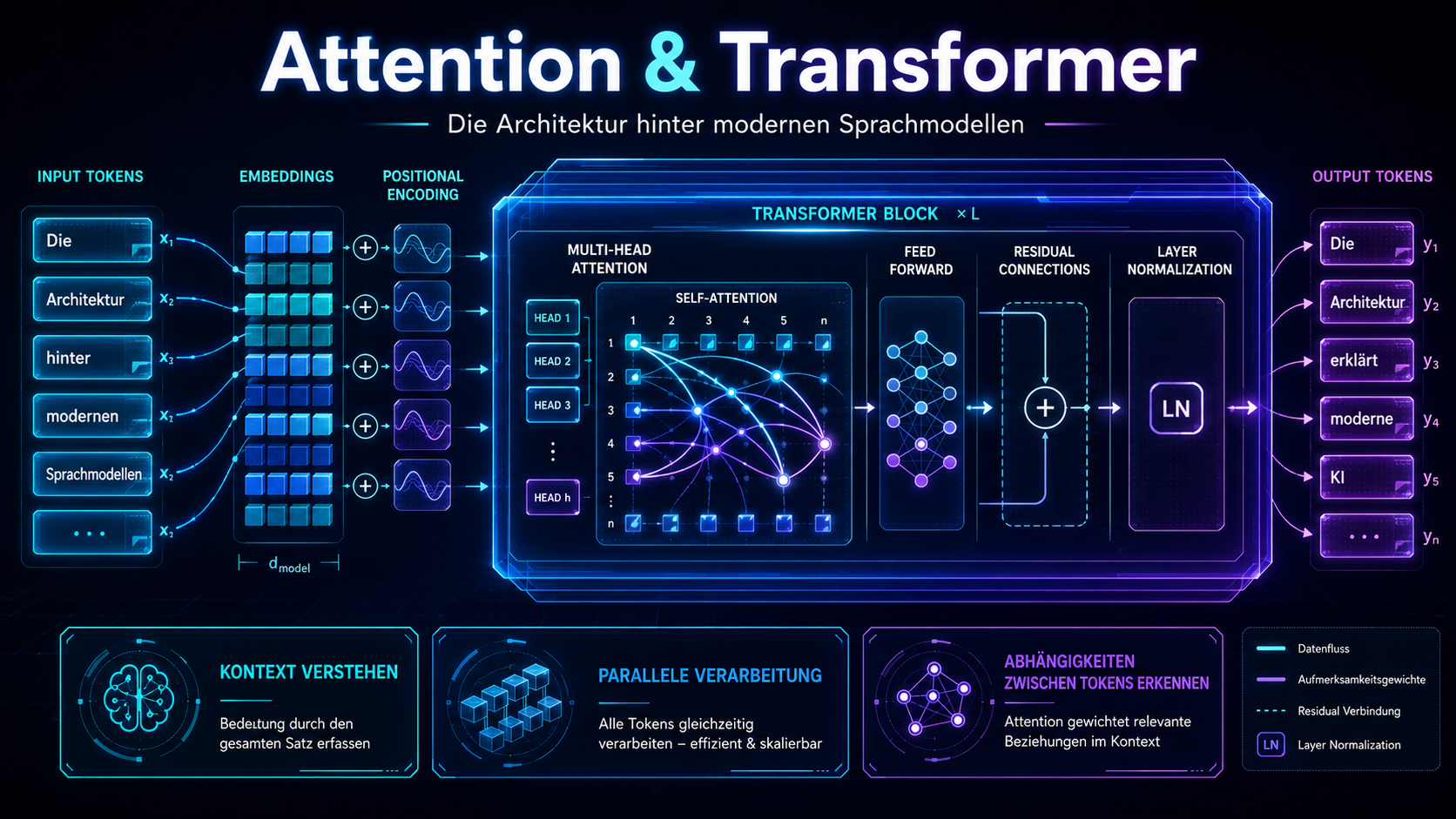
Behind every ChatGPT, Llama, Claude, Gemini, and every other modern language model sits the same architecture: the Transformer. Published in 2017, it displaced all prior architectures within a few years and in 2026 is the unchallenged base of nearly every productive AI system. Understanding its principles lets you choose models better, diagnose bottlenecks faster, and target optimization more precisely. This article explains it for technical decision-makers.
1. What came before the Transformer
Before 2017, recurrent networks (RNN, LSTM, GRU) dominated language processing. They process sequences token by token — each step builds on the previous. That has two problems:
- Sequentiality. Hard to parallelize because token N+1 must wait for N. Bad for GPU hardware.
- Long-range dependencies. Earlier tokens are forgotten in state, far-reaching dependencies get lost.
Various variants (attention-augmented RNNs, ConvNets for language) tried to help without fundamentally solving these problems. In 2017 the paper “Attention Is All You Need” arrived — and changed everything.
2. The attention idea
Attention is at heart a simple idea: each token gets to “look at all other tokens” and pull content from them, weighted by relevance. Concretely, in three steps:
- Query, key, value. Each token is projected into three vectors: a question (Q), a key (K), a value (V).
- Compute similarity. A token’s query is compared against every token’s key (dot product, then softmax). This yields a distribution over the sequence.
- Weighted combine values. Using this distribution, the values are summed with weights.
Result: every token “knows” how important every other token is for its own representation and pulls information accordingly. This works for language, image, audio, code — everywhere relationships between elements matter.
3. Self-attention and multi-head
Self-attention is attention on a single sequence: query, key, value all come from the same tokens. Every token can draw context from its own sentence/document. That’s the core of what Transformer LMs call “language understanding.”
Multi-head attention parallelizes this: instead of one attention operation with one Q/K/V projection, there are several (typically 8–96), each with its own learnable weights. Each head can focus on a different aspect — some on syntax (which words grammatically belong together?), some on semantics (who is the subject?), some on positional structures. Heads are then combined.
In large models, interpretable heads appear — see Mechanistic interpretability.
4. Anatomy of a Transformer block
A Transformer block combines several primitives:
- Multi-head self-attention. As above.
- Layer norm. Normalizes activations, stabilizes training.
- Residual connection. Input is added to the attention output — helps with vanishing gradients in deep networks.
- Feed-forward network. Two linear layers with a nonlinearity in between. Processes each token independently, adds model capacity.
- Another layer norm and residual.
These blocks are stacked — modern LLMs typically have 30–80. The architecture is homogeneous (same building block everywhere) and thus arbitrarily scalable.
In MoE models the feed-forward layer is replaced by a Mixture-of-Experts layer — see Mixture of Experts.
5. Positional encoding
A problem: attention is permutation-invariant. Shuffle tokens, and attention output is the same (modulo index confusion). But language has order. Solution: positional encoding augments each token embedding with positional information.
Methods:
- Sinusoidal positional encoding (original). Fixed, non-learned sine functions.
- Learned positional encoding. Trainable vectors per position. Works only up to the trained maximum length.
- Relative positional encoding. Position relative between tokens, not absolute.
- RoPE (Rotary Positional Embedding). 2026 standard. Rotates query and key based on position. Scales well to longer contexts.
- ALiBi. Linear bias penalty for distant tokens. Very simple, good generalization.
The choice affects how well a model generalizes to context lengths beyond training. More in Tokenization and context windows.
6. Why Transformers scale
Three structural reasons make Transformers ideal for scaling:
- Parallelism. All tokens can be processed in parallel. GPUs love this.
- Homogeneous architecture. Every block is the same. Architecture engineering reduces to “how many blocks” and “how wide.”
- Empirical scaling laws. Chinchilla, the GPT-3 paper, and follow-ups show: quality grows predictably with parameter count, data, and training compute.
That makes investments calculable. When you hear “doubling parameters and data yields X% quality lift” — you invest. This dramatically accelerated the AI industry 2020–2024.
7. Evolutions in 2026
The original Transformer is rarely productive unchanged in 2026. Important extensions:
- FlashAttention. Memory-efficient attention. 2026 standard.
- Grouped query attention / multi-query attention. Reduces KV cache memory.
- Mixture of Experts. Sparse activation. See Mixture of Experts.
- State space models (Mamba, S4). Transformer competition for very long sequences. Niche so far, growing relevance.
- Hybrid architectures. Transformers with Mamba layers, Mixture-of-Depths, selective state space. Exciting research area.
- Reasoning-specific architectures. Models with longer chains of thought — see Reasoning models.
The basic Transformer architecture remains, for the foreseeable future, the dominant choice for 95% of productive LLMs. Understanding it in 2026 isn’t optional learning but a baseline for anyone seriously working with LLMs — CTO, architect, or engineer. Without it most optimization decisions become guesses instead of engineering. With it a GPU investment becomes a calculable system with clear scaling paths.
Frequently asked questions.
/ 01What does 'Attention is all you need' mean?
It's the title of the 2017 paper that introduced the Transformer and revolutionized machine language processing. The thesis: previous architectures needed recurrent or convolutional blocks, the Transformer gets by almost entirely on attention. Result: better quality, better parallelism, simpler scaling.
/ 02What differentiates attention from previous methods?
Earlier methods (RNN, LSTM) process sequences step by step — token N waits for N-1. Attention lets every token interact with all others in one step. That's parallelizable (GPU-friendly) and captures long-range dependencies better.
/ 03What is self-attention?
Self-attention is attention where all three roles (query, key, value) come from the same sequence. Every token asks questions of all others, every token answers, every token provides content — all three operations on the same input. That's the core mechanism that gives Transformers language understanding.
/ 04What is multi-head attention?
Instead of one attention operation, several run in parallel (typically 8–96 heads), each with its own learnable projections. Each head can attend to different aspects — syntax, semantics, coreference, position. Results are combined. This greatly raises expressivity.
/ 05Why do we need positional encoding?
Attention is inherently permutation-invariant — it doesn't know token order. Positional encoding augments each token embedding with positional information. Modern variants like RoPE (Rotary Positional Embedding) and ALiBi enable longer contexts than the original absolute positional encoding.
/ 06Why do Transformers scale so well?
Three reasons: full parallelism (good for GPUs), homogeneous architecture (same blocks, arbitrarily stackable), and empirically demonstrated scaling laws — quality grows predictably with model size, data, and compute. These properties make investing in ever-larger models calculable, and thus attractive.