Mixture of Experts — MoE — is the second major architecture idea besides the standard Transformer that crossed from research into mainstream use in 2024 and 2025. Models like Mixtral and DeepSeek prove: instead of making a single model ever denser, you can combine many smaller experts and activate only some per token. The result: higher model capacity at moderate inference cost. This article explains how it works and where it shines.
1. Why Mixture of Experts in the first place
LLM scaling runs into a wall: more parameters = more memory, more compute, higher cost. A 70B model costs roughly 5× more per token than a 14B. Building still larger models hits hardware and budget barriers.
MoE sidesteps this by decoupling model capacity from active compute. An MoE model can have hundreds of billions of parameters — but only a few billion are activated per token. Capacity scales without proportional inference cost.
2. How an MoE layer works
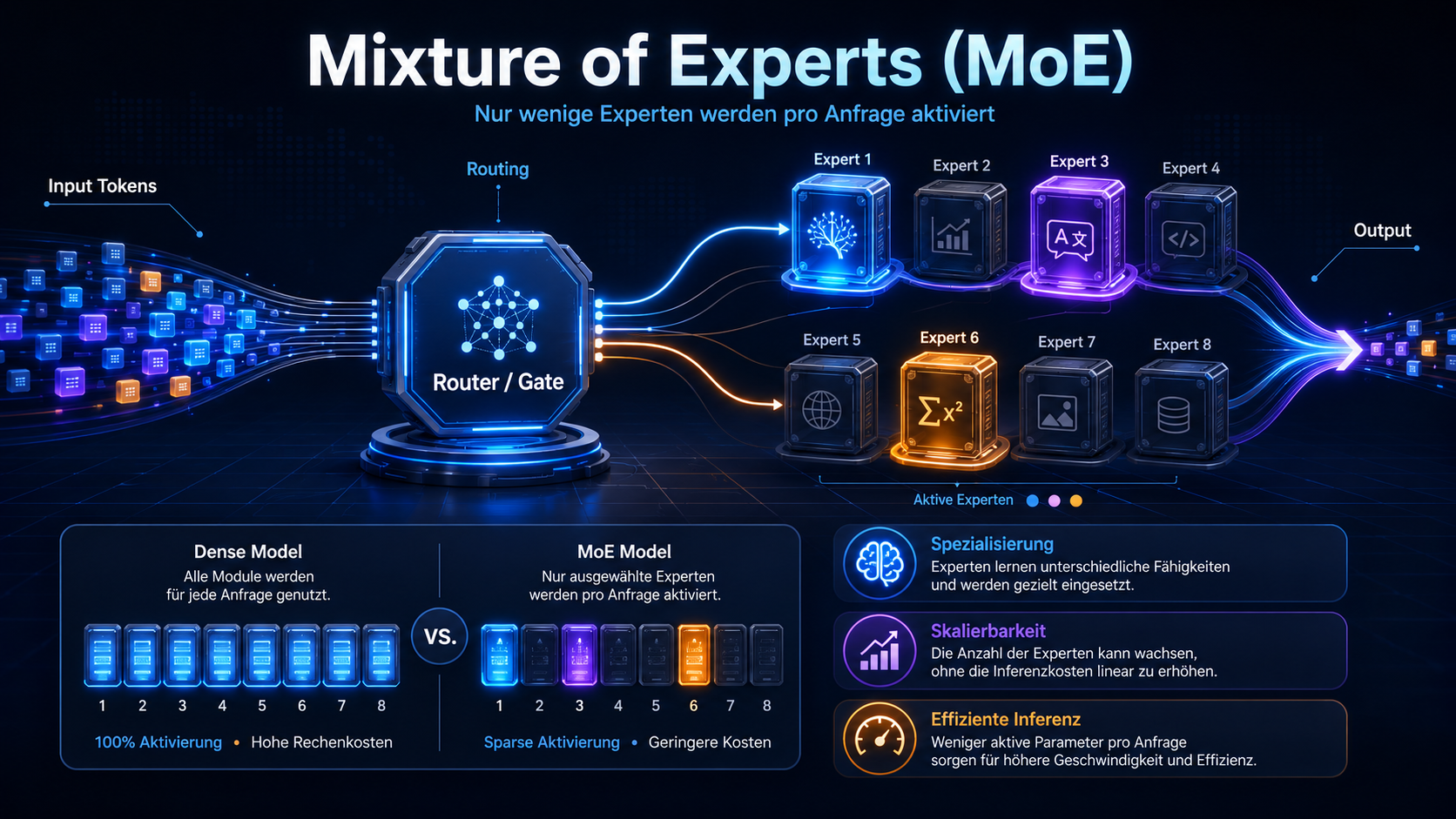
An MoE layer replaces a Transformer’s classical feed-forward layer with a collection of experts and a router:
- Experts. Multiple small feed-forward networks. Typical configurations: 8 experts (Mixtral 8x7B) or 64+ experts (DeepSeek-V3).
- Router. A small linear layer deciding which two or four experts to activate per token. Trained jointly — it develops a specialization structure during training.
- Sparse activation. Only selected experts execute. Results are combined with router-derived weights.
The attention layer usually stays dense — sparsity is introduced primarily in the feed-forward layers, which hold most of the model’s parameters.
3. The router as Achilles’ heel
The router is simultaneously MoE’s greatest strength and biggest challenge:
- Load imbalance. Without countermeasures, routers tend to activate the same experts. Some overload, others learn nothing. Solution: auxiliary loss enforcing balanced utilization.
- Expert collapse. Rarely-chosen experts stagnate. Solution: minimum token quotas or dynamic re-routing.
- Stability. Router decisions are discrete (top-K selection), complicating gradient flow. Various strategies (Switch Transformer, Expert Choice, Soft MoE) tackle this.
In modern MoE models, router engineering is often what separates a training that converges from one that stalls.
4. Important MoE models in 2026
- Mixtral 8x7B and 8x22B (Mistral). Open weights, well established, lots of tooling. Mixtral 8x22B (~141B total, ~39B active) is a workhorse for mid-market deployments.
- DeepSeek-V3 and DeepSeek-R1. 671B total, 37B active. Open weights, top tier on reasoning tasks. See Reasoning models.
- Qwen MoE variants. Solid performance, broad multilingual support — especially relevant for DACH markets with strong German pretraining.
- Grok-1 (xAI). 314B total, 25% active. Open weights under Apache 2.0.
Many commercial models use MoE internally without highlighting it — GPT-4 class, Gemini Ultra, Claude.
5. What MoE delivers in practice
Three core benefits:
- Better quality per inference FLOP. An MoE with 13B active parameters typically matches a dense 30–50B model — at inference speed similar to a 13B.
- More efficient training. Pretraining FLOPs spread over more parameters; effective data utilization rises.
- Specialization. During training, experts develop specializations (code, math, multilingual), which lifts quality on heterogeneous workloads.
For enterprises this means: an MoE often performs more consistently across mixed-task workflows than a dense model of comparable inference cost.
6. Challenges and trade-offs
MoE isn’t a silver bullet:
- Memory. All experts must be loaded, even if only a few are active per token. Mixtral 8x22B in FP16 needs ~280 GB — multiple GPUs.
- Inter-node communication. In large MoE setups, experts spread across GPUs. Token routing between nodes costs bandwidth.
- Batch efficiency. When tokens hit different experts, batching fragments. vLLM and specialized MoE inference stacks address this.
- Fine-tuning complexity. LoRA on MoE models is possible but the router needs care. Naive LoRA on all experts inflates training cost.
7. When MoE is relevant for businesses
MoE pays off particularly when:
- Heterogeneous workloads. Multiple task types with different demands (code, language, math).
- Higher quality at moderate cost. You want quality close to large dense models without the inference price tag.
- On-premise with sufficient GPU memory. With 80–160 GB GPU memory available, Mixtral 8x22B in 4-bit is often the best choice. Details on quantization in QLoRA and quantization.
- Reasoning-heavy applications. DeepSeek-R1 as a reasoning MoE delivers top-tier multi-step quality. More in Reasoning models.
For small models (under 7B active) and simple tasks, dense models remain the better choice — MoE overhead pays off only above a certain size.
Mixture of Experts in 2026 is no longer a research curiosity but a productive architecture decision. If you want to operate large models on your own infrastructure, you can hardly avoid MoE. The right choice between dense and sparse depends on the use case, the hardware, and engineering maturity. With the right infrastructure and tooling, MoE delivers substantially more than an equally expensive dense model — provided you know its limits.
Frequently asked questions.
/ 01What does 'sparse activation' mean in MoE?
In a classical Transformer every token flows through all parameters of a layer. In MoE each token passes only through a small subset of experts — typically two of eight or two of fourteen. The remaining experts stay idle for that token. MoE thus decouples total capacity (all parameters) from active compute (active parameters only).
/ 02Are MoE models better than dense models?
At equal inference speed, often yes. An MoE with 8×7B (Mixtral 8x7B) has 47B total parameters but only ~13B active per token. It typically beats a dense 13B and approaches a dense 70B — at inference speed close to the 13B.
/ 03Why aren't MoE models standard everywhere?
They have several practical downsides: higher total memory (all experts must be loaded), more complex training (router stability, load balancing), trickier deployment (expert parallelism, inter-node communication). For many applications the extra effort only pays off above certain model sizes.
/ 04What's the router in MoE?
A small neural network (often a single linear layer + softmax) that decides per token which experts to activate. The router is co-trained — it's the heart of the model and determines how specialization spreads across experts.
/ 05Which open-weight MoE models matter in 2026?
Mixtral 8x7B and 8x22B from Mistral, DeepSeek-V3 and DeepSeek-R1 (reasoning MoE), Qwen MoE variants, Grok-1, and a few specialized research models. DeepSeek-V3 with 671B total parameters (37B active) is one of the strongest open-weight models in 2026.
/ 06Can I run MoE models on-premise?
Yes, but hardware needs are higher than for a dense model of similar active size — because all experts must sit in GPU memory. Quantization helps a lot: a quantized Mixtral 8x22B fits on an 80-GB GPU. Details in QLoRA and quantization.