In November 2024, Anthropic introduced a new open protocol. The name was awkward — Model Context Protocol — the press release short, the attention moderate. Two years later, it has quietly become arguably the most consequential standard in the AI world, without most observers noticing the transition. 97 million monthly SDK downloads. Over 9,400 public MCP servers. 78 percent of enterprise AI teams have at least one MCP-based agent in production. Anthropic, OpenAI, Google, Microsoft, and AWS officially support the standard. What was an Anthropic-internal tool in 2024 is the foundation for serious enterprise AI integration in 2026.
This piece situates what MCP delivers technically, why this particular standard prevailed — and how we’ve been using MCP at createIF Labs in research and customer projects for over a year.
1. From Anthropic project to industry standard
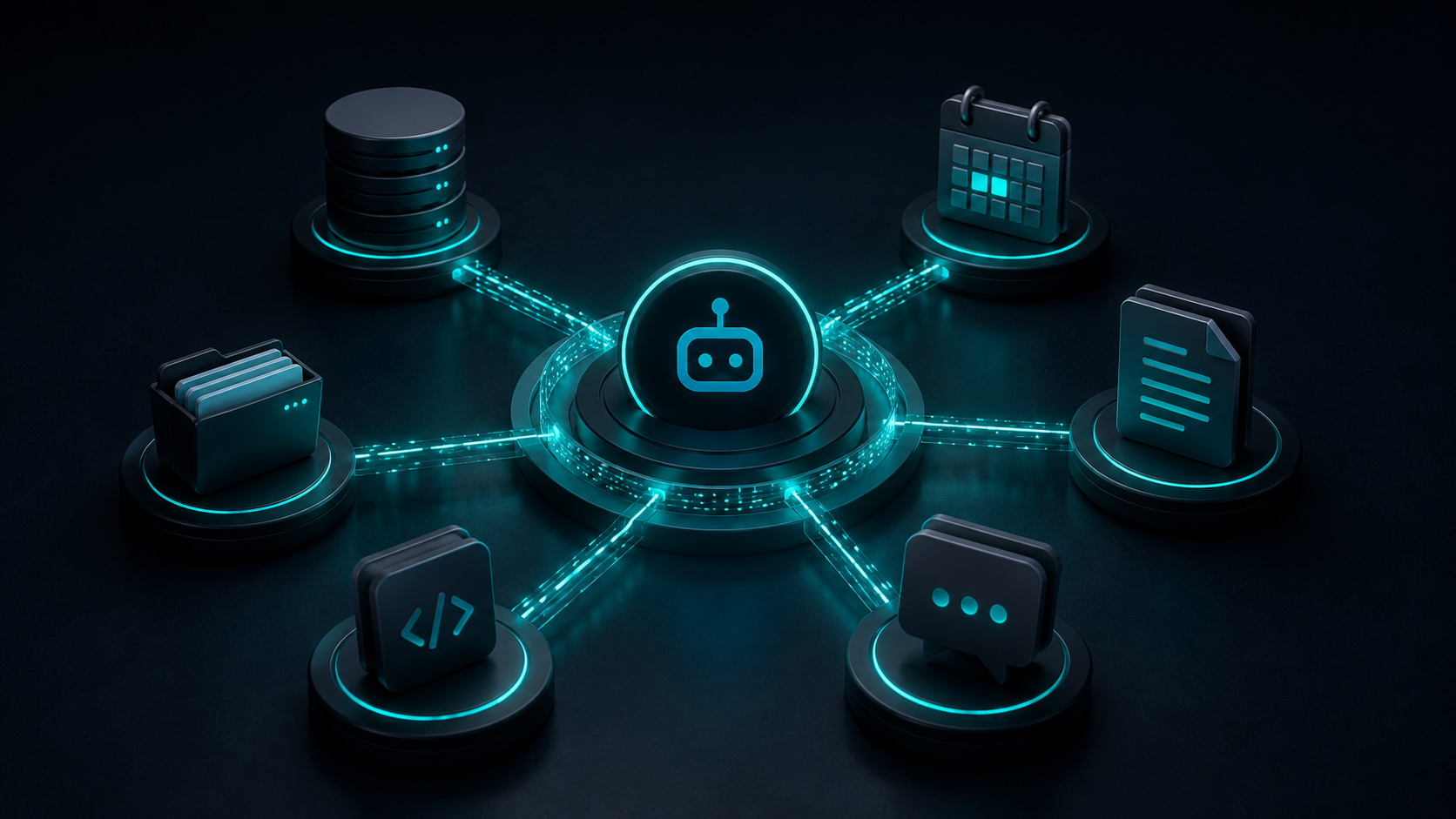
Anthropic’s announcement in November 2024 was typically understated: an open protocol that would solve the “M×N integration curse” — the fact that M models times N tools equals M·N individual integrations. Instead of 1,000 bespoke connectors, the world needed one standard.
What happened next can be told in three phases:
Phase 1 — Anthropic ecosystem (Dec 2024 – April 2025). First MCP servers for GitHub, Slack, Google Drive, local filesystems. Claude Desktop integrates MCP natively. Early adopters are open-source enthusiasts and individual engineering teams. SDKs available in Python and TypeScript.
Phase 2 — First cross-vendor movement (May 2025 – Oct 2025). OpenAI announces official MCP support, Cursor and other coding IDEs integrate MCP client capability. First enterprise pilots go public. A critical mass of server implementations emerges — from database connectors to industrial specialty systems.
Phase 3 — Standardization (Nov 2025 – today). Google, Microsoft, and AWS adopt MCP officially. Cloudflare, Replicate, Pinecone, Weaviate, and hundreds of other vendors ship MCP servers. The protocol evolves through an open spec process with contributions from across the ecosystem. Enterprise platforms (Microsoft Copilot Studio, Azure AI Foundry, AWS Bedrock, Vertex AI) make MCP the standard integration option.
The remarkable thing: adoption ran faster than for comparable standards. HTTP took 5 years to dominate. REST about 8. MCP achieved in 18 months what other protocols managed in half-decades — driven by the AI world’s acute need for a common vocabulary.
2. The numbers in 2026
The quantitative picture mid-2026:
- 97 million monthly SDK downloads across the five official language SDKs (Python, TypeScript, Go, Java, Rust). Trend rising.
- 9,400+ public MCP servers in open registries (mcpservers.org, awesome-mcp, and comparable directories).
- 78% of enterprise AI teams have at least one MCP-based agent in production (source: 2026 Enterprise AI Adoption Survey by a leading analyst firm).
- Median time-to-first-integration: 3 days. Pre-MCP tool-calling integrations typically took 3–6 weeks.
- Cross-vendor compatibility: an MCP server written for Claude works without code changes with GPT-5, Gemini 2.5, Llama 3.3, and every other MCP client.
What these numbers mean in practice: an SMB building an MCP server for its ERP system today isn’t bound to a model vendor. The same server code works with the closed-source provider of today and the open-weight model of tomorrow.
This vendor independence is the real reason MCP prevailed. Standards don’t win because they’re technically elegant. They win because they solve economic problems — and single-vendor model lock-in was the biggest risk in any 2024 AI architecture decision.
3. What MCP delivers technically
MCP defines a clear, lean architecture:
Actors:
- MCP client. An LLM application — Claude Desktop, a coding tool, an enterprise agent platform.
- MCP server. A component that exposes defined resources — tools (functions), resources (data), prompts (pre-built tasks).
- Host. The process the client runs in — typically the user or service context.
Three main concepts:
Tools. Functions the LLM can call. Each tool has a name, a description (read by the LLM), and a JSON schema for arguments. Example: create_jira_ticket(project, summary, description).
Resources. Data the LLM can read — files, datasets, documents. When the LLM context doesn’t carry everything up front, it can load resources on demand. Example: a resource endpoint that streams documents from a knowledge base.
Prompts. Pre-built task formulations that the client can offer. Example: a prompt “Generate a weekly report from these data,” triggered by the user via keyboard shortcut.
Transport layer. MCP typically runs over stdio (for local processes) or HTTP+SSE (for network servers). Streaming responses, bidirectional notifications, lifecycle events are part of the spec.
Authentication. OAuth 2.1 with PKCE is standard since spec version 2025-06. Tokens are acquired by the client and passed to the server; the server enforces permissions server-side.
Capabilities. Client and server exchange at handshake what they support — which tools, which resources, which auth, which streaming features. The protocol versions cleanly and remains backward-compatible.
The elegance: MCP doesn’t try to be everything. It’s explicitly not a generic RPC solution. It’s a bridge between LLM inference and external reality, optimized for exactly that use case.
4. Why it’s the HTTP for AI agents
The comparison to HTTP is now routinely drawn — and it holds up surprisingly well.
What HTTP did for the web: a unified protocol that connected arbitrary clients (browsers, mobile apps, server-to-server) with arbitrary servers. Before HTTP, hundreds of proprietary protocols existed. HTTP made the web possible as an ecosystem.
What MCP does for AI agents: a unified protocol that connects arbitrary LLM clients (chat frontends, coding IDEs, enterprise agent platforms) with arbitrary enterprise systems. Before MCP, hundreds of proprietary tool integrations existed per model vendor.
Four structural parallels:
- Verb-noun separation. HTTP has GET/POST/PUT/DELETE. MCP has tools.call, resources.read, prompts.get. In both cases, action is decoupled from content — and that’s the precondition for genericity.
- Capability negotiation. Both protocols negotiate what both sides support (HTTP versions, MCP capabilities). This enables incremental evolution.
- Stateless tendency. Both HTTP and MCP are primarily stateless at their core. State lives in the client and is carried via tokens. That makes scaling trivial.
- Open standardization. Both standards evolve in open forums — no single vendor controls the roadmap, which accelerates trust and adoption.
What MCP — like HTTP before it — makes possible: an entire new ecosystem of tools that can work together without each one pre-integrating with each other. An SMB builds an MCP server for its warehouse management system without knowing which LLM applications will use it — and without worrying that they’ll have to start over in two years.
5. MCP in createIF Labs’ practice
We’ve been building with MCP since early 2025. In current projects — research and customer work alike — MCP isn’t an add-on but the architecture default.
Research projects 2025/2026:
- Sovereign agent platform. An internal platform that bundles generic agent capabilities (routing, retry logic, audit logging, tool selection). All data access runs over MCP servers. A customer with their own ERP plugs in an MCP server, and the agent can use it immediately — no code change in the platform.
- Multi-model inference layer. An inference layer that routes between multiple models (Llama 3.3, Mistral, Qwen3, Claude) — depending on task type, cost, and data sensitivity. All models speak MCP, so routing becomes a pure architecture question, not model-specific.
Customer projects with MCP:
- Industrial Mittelstand company. MCP servers for SAP modules, internal wiki, and a custom engineering database. An internal AI assistant uses these servers to answer technical queries and prepare engineering documents. Data never leaves the plant.
- Mid-size insurer. MCP servers for internal policy, claims, and customer databases. An underwriting assistant pulls context for risk assessments through these servers — auditable, co-determined, GDPR-conformant.
- Software shop. MCP servers for GitHub Enterprise, internal ticket system, and CI/CD pipeline. A coding assistant builds on these servers — from pull-request reviews to automated test generation.
The experience across these projects: MCP cuts integration effort by 3–5x compared to pre-MCP implementations. What took weeks 18 months ago takes days today. More importantly: what we built in 2025 still runs in 2026 — and will keep running in 2028, because the protocol is stable.
6. Where MCP still falls short
MCP is far along in 2026, but not done. Three areas are actively in motion:
Authentication in complex enterprise setups. OAuth 2.1 with PKCE covers many cases, but multi-tenancy, service accounts, short-lived tokens, and tiered authorization systems demand more care. Anthropic and Microsoft are working on specific enterprise extensions. Until then, custom auth logic is part of many MCP server implementations.
Multi-tenancy. MCP servers serving multiple customers concurrently need data-level isolation that the standard doesn’t prescribe directly. In practice, implementations solve this via token scoping and clean server-side auth, but standardization isn’t as advanced as for the core protocol.
Governance and compliance. Who is allowed to use which MCP server, how permissions are rolled, how audit logs are centralized — all possible, but implemented per organization. We see a growing need for an “MCP gateway” that centralizes these governance and compliance layers. Early open-source projects head in that direction; standardization is pending.
Also: the model end isn’t always perfect. Weaker LLMs make poor tool-selection decisions, hallucinate tool arguments, or grant overly permissive actions. Here, guardrails, evals, and prompt injection protection help — even with a stable protocol, the LLM layer remains a trust zone that must be maintained.
7. What decision-makers should do now
Concretely and practically:
- Inventory your internal systems. Which five to ten systems generate 80% of the value if an AI agent can work with them? Typical candidates: ERP, CRM, ticket system, knowledge base, document management, mail archive.
- Build the first MCP server for your most important system. Read-only first, with clean auth and logging. 2–3 weeks of effort, depending on the existing API quality.
- Evaluate LLM clients. Which LLM applications should use your MCP servers? Coding tools, internal agents, external consulting tools? Make MCP compatibility a selection criterion.
- Standardize governance. Who builds MCP servers, who reviews them, who operates them? Who has which permissions? Who audits usage? These organizational questions matter more than the technical ones in 2026/2027.
- Watch the spec evolution. Multi-tenancy, enterprise auth, and governance will sharpen in upcoming spec versions. Companies that start early benefit immediately.
What you shouldn’t do: wait. Standards don’t win by waiting for the next major release. Companies using MCP today build the experience that, in 12 months, will mark the difference between “we use AI” and “AI is part of our architecture.”
We’ve covered the technical mechanics in detail in Tool Calling, Function Calling and MCP. If you want to know which MCP server in your company will deliver the first ROI: let’s talk. We build the stack that doesn’t just work today but that you’ll still be using in 2028.
Frequently asked questions.
/ 01What is MCP in one sentence?
The Model Context Protocol is an open protocol that connects AI applications to external data sources and tools in a standardized way — comparable to HTTP for web services or USB for hardware peripherals.
/ 02Why a standard for AI tool calls at all?
Without a standard, every tool integration had to be built individually for each model and each platform — a combinatorial explosion. With MCP, a company writes one server for its internal system (e.g. Jira, SAP, custom database), and every MCP-capable LLM application can use that server immediately. M×N integrations become M+N.
/ 03Which vendors support MCP in 2026?
Anthropic (originator), OpenAI (officially adopted in 2025), Google (Gemini family and Vertex AI), Microsoft (Copilot Studio, Azure AI Foundry), AWS (Bedrock), Cloudflare, Replicate, plus many tool vendors (Cursor, Cody, Continue, Cline, Claude Desktop, Microsoft Copilot). Effectively every serious LLM application now.
/ 04How is MCP different from OpenAPI?
OpenAPI describes web services statically. MCP is purpose-built for LLM interaction: tools are described so the LLM understands when to use them; resources can supply context; prompts can offer pre-built tasks. MCP also has a standard for authentication, streaming, and lifecycle events. OpenAPI is static documentation; MCP is a runtime conversation.
/ 05Can I use MCP on-premise?
Yes, that's the default for sensitive data. MCP servers run wherever the LLM runs — typically inside your own network. Data doesn't leave the trust boundary. That makes MCP ideal for sovereign-AI architectures, and it fits directly into our recommended Sovereign AI Stack 2026.
/ 06How much effort is implementing an MCP server?
For an existing internal system with a clean API: 1–3 days for a functional server, 1–2 weeks for a production version with auth, rate-limiting, and audit logging. SDKs are available in Python, TypeScript, Go, Java, and Rust. The learning curve is shallow once you understand the concepts (tools, resources, prompts).
/ 07What does this mean for existing tool-calling implementations?
Tool calling remains the technical foundation — see Tool Calling, Function Calling and MCP. MCP is the standardization layer on top. If you're building a new system in 2026, think MCP from the start. Existing tool-calling integrations can migrate to MCP incrementally without being torn down at once.