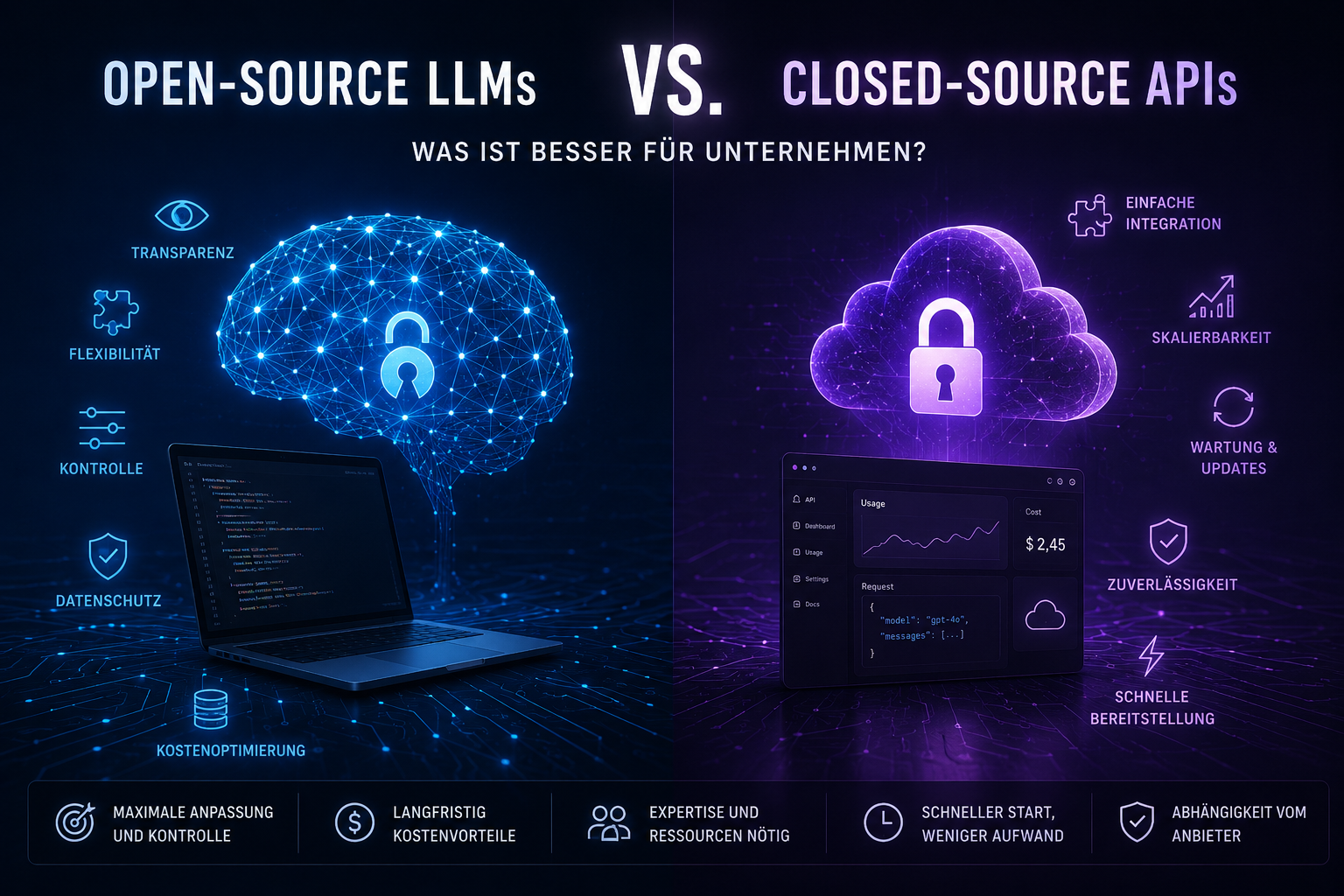
The choice between open-source LLMs and closed-source APIs in 2026 isn’t a mere tech question — it’s a strategic decision with effects on data sovereignty, economics, compliance, and maintainability. Both worlds have evolved, both have strengths. This article delivers a sober side-by-side along the criteria that actually matter in practice.
1. The state of play in 2026
Open-source LLMs have grown up. Llama 3.x, Mistral, Mixtral, Qwen, DeepSeek-V3 and R1 reach qualities that in 2023 were exclusive to commercial vendors. Closed-source models (GPT line, Claude, Gemini) have also advanced and defended their lead in some top-end disciplines.
For enterprises this means: there’s no blanket answer anymore. Choice depends on workload profile, compliance posture, engineering maturity, and budget. Picking one side without seriously evaluating the other leaves substantial optimization on the table.
2. Quality — a shrinking gap
On standard benchmarks (MMLU, GSM8K, HumanEval) the best open-source models in 2026 sit on par with leading closed-source models on many disciplines. Examples:
- Llama 3.x 405B / 70B. Solid all-rounder, broadly good, leading on some benchmarks.
- DeepSeek-V3 / R1. Top quality in reasoning and code, open weights under MIT license. More in Reasoning models.
- Mistral Large / Mixtral 8x22B. Strong in multilingual applications, good in German.
- Qwen 2.5 / 3. Good on structured tasks and Asian languages.
Closed-source still leads in some top disciplines — complex reasoning, very long conversations, some languages, and multimodal tasks. For 80–90% of business applications the practical quality gap is irrelevant. Several of these open models, including Mixtral, rely on a mixture-of-experts architecture to reach this quality at lower inference cost.
3. Cost and economics
Cost depends on request volume.
Closed-source APIs:
- Low entry cost (no capex for hardware).
- Linear scaling with volume — expensive at high volumes.
- Typical 0.5–60 USD per million tokens, model dependent.
Open-source self-hosting:
- Fixed cost for hardware or cloud GPU (1,500–10,000 EUR/month).
- Marginal cost per token very low (electricity, maintenance).
- Pays off clearly from ~10–50 million tokens per month.
At very high volume (multi-billion tokens monthly) open-source is 3–10× cheaper than closed-source. At low volume (under a million tokens monthly) closed-source is more practical. More on inference mechanics in LLM inference. Quantization and QLoRA can cut the hardware footprint of running open-source in-house even further.
4. Data protection and compliance
Open-source’s greatest strength.
Closed-source APIs:
- Data typically flows to US clouds (even with EU endpoints).
- Contractual assurances yes — technical guarantees limited.
- GDPR-compliant use possible, but with effort.
- AI-Act-relevant high-risk use cases often need deeper auditability than API providers can deliver.
Open-source self-hosting:
- Full data sovereignty. Data doesn’t leave your infrastructure.
- GDPR and EU AI Act can be fully documented.
- Air-gapped deployments possible for highest security.
- Compliance audits easier, because data paths are transparent.
For sensitive sectors — finance, healthcare, public sector, defense — open-source is often the only viable choice. More in Secure AI integration.
5. Vendor lock-in and strategic risks
Closed-source APIs lock you to a vendor:
- Price changes. Vendors can raise prices or change models.
- Model swap. Older versions are retired — your application has to react.
- Political risk. Export controls, sanctions, geopolitical shifts can restrict access.
- Output licenses. Some vendors prohibit training competing models on their outputs.
Open-source lock-in doesn’t exist technically — model weights are yours, the model runs where you decide, for years without forced migration.
6. Customizability and sovereignty
Open-source allows deep customization:
- Fine-tuning on your data. Full fine-tuning, LoRA, distillation — see RAG, fine-tuning or prompt engineering.
- Mechanical integration. Model directly in your inference stack, with custom optimizations.
- Model inspection. Mechanistic interpretability, probing, weight analysis — see Mechanistic interpretability.
- License and supply-chain clarity. Model provenance is verifiable.
Closed-source APIs offer limited customization (partial fine-tuning, RAG always, LoRA rare). Inspection is impossible — the model is a black box.
7. Hybrid setups as standard
In 2026 consulting projects we almost always recommend hybrid architectures:
- Open-source on-premise or EU cloud for bulk workloads, sensitive data, high-volume queries.
- Closed-source APIs for top quality, rare edge cases, multimodal tasks.
- Routing layer decides per request, based on content, sensitivity, and cost profile.
A typical split in a real architecture:
- 80% of requests → Llama 3.1 70B on-premise with a LoRA adapter
- 15% → DeepSeek-R1 for reasoning
- 5% → Claude/GPT-4 for multimodal or particularly complex edge cases
This setup balances cost, quality, and sovereignty. It demands engineering maturity but pays off noticeably at mid volumes.
The “open or closed” question in 2026 is rarely framed right. The better question is: “Which shares of my workload belong where, and how do I manage that uniformly?” Answering that builds an AI architecture combining sovereignty and pragmatic top quality. Ignoring it and picking a side either overpays on vendor fees or surrenders quality too early. Migration paths today are better documented than ever — and they pay off.
Frequently asked questions.
/ 01Which open-source LLMs are production-ready in 2026?
Llama 3.1/3.2 (Meta), Mistral and Mixtral, Qwen 2.5/3 (Alibaba), DeepSeek-V3 and R1, Phi-4 (Microsoft). For many enterprise use cases these models are on par with closed-source alternatives in quality and stability — with full data sovereignty and no vendor lock-in.
/ 02Are closed-source models qualitatively better?
In top-end disciplines like complex reasoning or some language coverage, often still yes. But the gap is shrinking: DeepSeek-R1 and newer Llamas match GPT-4 or Claude on many benchmarks. For most business applications the quality difference is practically irrelevant.
/ 03When does a closed-source model make more sense?
When peak quality on open, broadly distributed tasks is required, request volume stays moderate, no compliance obstacle exists, and no internal ML team is available to run an open-source setup. In those cases the monthly API bill is the simpler path.
/ 04What compliance advantages does open-source offer?
Full data sovereignty, on-premise deployments possible, no data flow to US clouds, clear license terms, GDPR-compliant implementation. Especially relevant in regulated sectors (finance, healthcare, government) and under the EU AI Act.
/ 05What does open-source LLM infrastructure cost?
Single-model inference on an 80-GB GPU (e.g. H100 or L40S) at German hosters runs ~1,500–3,500 EUR/month for hardware. Plus engineering for setup and operations. Above ~10–50 million tokens per month, open-source is cheaper than typical APIs.
/ 06Can open- and closed-source be combined?
Yes — that's almost the standard in 2026. Sensitive data and high-volume workflows run on open-source on-premise. Top-quality tasks or rare edge cases go to closed-source APIs. A routing layer decides per request — see LLMOps.